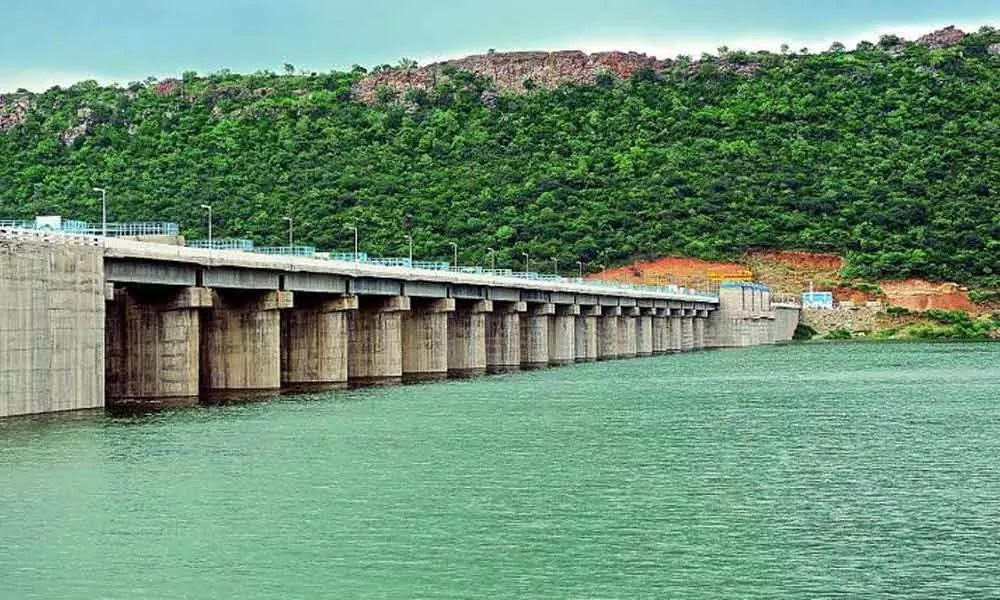
The principal reservoirs along the Krishna River have experienced a significant decline in storage capacities, with levels currently below 50% of the total capacity of 589.67 TMCs, raising an alarm among farmers who heavily depend on these reservoirs for their Rabi season crops. The key irrigation sources for the Krishna Delta and Nagarjuna Sagar Ayacut area include major reservoirs such as Srisailam, Nagarjuna Sagar, and Pulichintala Projects.
Presently, the aggregate water stored in these reservoirs stands at 239.44 TMCs, representing a mere 40.41% of the overall reservoir storage capacity.
The Krishna Delta Ayacut, spanning Krishna, NTR, Guntur, Prakasam, and Eluru districts, relies on the Pulichintala Project, which receives water from the Nagarjuna Sagar and Srisailam projects. A minimum of 60 TMCs to 70 TMCs of water is required for cultivating Rabi crops. However, due to insufficient water storage, farmers are grappling with irrigation water shortages this Rabi season, with only around 13 TMCs currently available.
According to the latest update, the major Srisailam Project holds 61.03 TMCs of water storage against its gross capacity of 215.81 TMCs at the Full Reservoir Level (FRL), indicating a water storage of 28.28% compared to its total capacity. Similarly, the Nagarjuna Sagar Project (NSP) has 157.23 TMCs of water storage, accounting for 50.39% of its total capacity of 312.95 TMCs. Meanwhile, the Pulichintala Project reports a meagre 13.83 TMCs of water storage, representing just 30.21% of its total storage of 45.77 TMCs.
Andhra Pradesh is facing a substantial rainfall deficit, with the North East monsoon recording only 65.70 mm of rainfall compared to the normal of 255.90 mm, reflecting a deficit of 74.30%. The southwest monsoon also witnessed a shortfall of 15.20%, with actual rainfall recorded at 487.70 mm against the normal of 574.70 mm. Overall, the average rainfall in Andhra Pradesh from June 1 to date stands at 552.90 mm, indicating a deficit of 22.4% compared to the normal as of date, which is 830.60 mm.
According to data from the Agricultural Department, six districts, including Vizianagaram, Parvatipuram Manyam, Alluri Sitaramaraju, Krishna, and Chittoor, have experienced normal rainfall, while the remaining 20 districts face a rainfall deficit.
Officials from the Agricultural Department reported that Rabi crops cultivated in the Krishna district cover 1.56 lakh hectares, while in the NTR district, the coverage extends to 35,191 hectares. Due to water storage shortages in major reservoirs, Krishna district farmers have cultivated 1,283 hectares, with NTR district farmers covering 4,155 hectares thus far.
In response to the challenging conditions, the combined Krishna district Irrigation Advisory Board (IAB) and Agricultural Advisory Board meetings passed a resolution advising against Paddy cultivation in the Rabi season. Farmers were also urged to avoid Maize cultivation due to its high water consumption, with authorities recommending alternative crops.
Krishna Central Division (KC Division) Executive Engineer PVR Krishna Rao acknowledged the declining water levels in major reservoirs. He highlighted that while the NSP retains 157.23 TMCs of water, only 26 TMCs remain consumable out of the total allocated water for the Krishna Delta. The Pulichintala Project’s storage capacity is dwindling, currently holding 13.83 TMCs.
Water levels fall in Krishna reservoirs DASARI SRINIVASA RAO
- Advertisement -