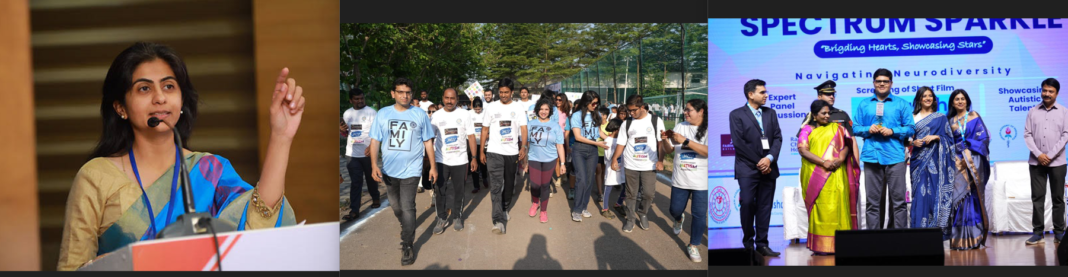

Dedicated to supporting different causes, including autism, thalassemia, and issues of transgender people, The Pioneer brings to you the NGO Marham Resonating Resilience, as we connect with the founder on the causes.
SHIKHA DUGGAL
“The question is not what I have achieved, but what have I done for others to achieve?” said His Highness Aga Khan. This feeling was the driving force behind the founding of the NGO Marham Resonating Resilience in Hyderabad. Their goal with Marham is to make every moment of tears valuable, every heart unique, and every smile that is lost come back. They went through several delicate subjects to try to make a difference in the lives of at least a few people. They have, in fact, begun working on issues including autism, thalassemia, and transgender people.
We find out more in an exclusive interview with the founder, Dr. Nabat Lakhani: “As the founder, I was already very clear about the kind of philanthropy I wanted to perform in the city and for the people living in the city when I first arrived here in Hyderabad. Something truly remarkable! My main goal was to tell the tales of the unsung heroes. I began with a magazine that had stories that weren’t very popular or successful but that did highlight a number of the difficulties they had overcome.”
In the stories that she wrote, she first encountered a group of transgender people. Later, she came across two autistic champions named Varun and U said, whose tales touched her differently—as if they had always been family. Also an obstetrician-gynaecologist, she shares, “They grew closer to me as I learned more about them and listened to them more. One of my family members has major thalassemia; thus, I felt our nation needed to take action to stop something preventable.”
To raise awareness of thalassemia, Marham organised a panel discussion with representatives from all relevant fields, such as gynecologists, hematopathologists, pediatricians, blood bank pathologists, and parents. The goal was to reach a consensus and persuade them that the most effective way to prevent this fatal disease is through antenatal screening for thalassemia. She also mentioned, “We didn’t end there, either. Depending on the lab, the test can cost between Rs. 1500 and Rs. 4000. After almost seven months of steadfast work despite many obstacles, Marham started persuading gynecologists to screen all pregnant and planning couples at just 200. Now, after nearly seven months of hard work, we are almost at the finalisation of our tie-up with the Telangana Health and Family Welfare Department, where tests will be performed at no cost.”
They produced a short video about autism; the performers are all autistic, and it was shown in front of the governor. It has taken home multiple awards and is currently undergoing testing on over-the-top platforms to educate the public about autism and the fact that people with autism are not disabled. In addition, she emphasises, “We conducted a walk and encouraged other bloggers and Instagrammers to talk about it for it to spread further. The autism odyssey was a two-day conference that I created out of my brainchild’s desire to bring together all the players involved in improving these people’s lives, whether it be in education, therapy, a job, or other areas. With it, we held a cultural event to highlight the Asd’s abilities and demonstrate inclusivity. We opened the first autism discussion forum in Hyderabad to meet the goal of providing support for every parent who asks, “What’s next for us?”
The foundation has asked the Telangana CSR Wing Director to assist them in getting brochures about their people on the spectrum to businesses so they may place orders and hire them. Aside from that, “Transgender rights are to live inclusively in the society like any of us. We have received assistance with regular medical difficulties and medication, having undergone surgery twice. We educated three transgender people to manage a cloud kitchen. The difficulties we encountered were that if they choose to go begging or work as prostitutes, they make far more money than if they struggle to acquire orders and make a little money. They set up kiosks at New Year’s Eve celebrations and also gave orders in the city’s best hospitals. We’ve discovered that, although they have few opportunities, they are extremely forgiving of even tiny mistakes, just like any other hotel, and as the founder of Marham, I took the brunt of the consequences.”
Then their literary works support inclusion by encouraging those who are stigmatised to tell their stories and come out to live on par with society. They also try to integrate them at different levels in their works before even urging others to do the same. For instance, “When we discuss employment with people who have autism, we first offer them jobs in different capacities within our own businesses, as well as those of our friends and family, and then we push society to follow suit. We place more faith in deeds than in words. Collaboration and teamwork, in my opinion, can only slightly alter the marginalised work we are trying to do. For a greater impact, it is crucial to unite individuals working on related projects in clusters under one roof.”
What about their turning points? Alright, together with spouse screening, they have examined over 1000 samples for thalassemia major, with a 4% detection rate. Although parent groups already exist, they have launched the first-ever forum just for individuals with autism. However, the founder’s goal was for the individuals to have a voice that goes beyond their parents, just like any of them. More than 100 members have enlisted thus far. They created the first awareness film, which isn’t a documentary and features acting by autistic people themselves. It has four festival victories. They are still employing people with autism in a variety of ways. They have taken care of the needs and outings of the thirteen girls they adopted from an orphanage, as well as their English and soft skills training.
The achievements don’t stop there: “We have funded four college degrees for the city’s impoverished families. We have several locations set up for menstruation products, literature, and rations for different city slums. We’ve established libraries in two slum education centers. We conducted a free breast screening event featuring heavily discounted scans and patient follow-ups (we screened 150 people, of whom 3 were identified and received treatment). We have been successful in persuading the Telangana government to collaborate with private practitioners to test patients for thalassemia at a modest cost of only Rs. 200. We are currently doing the first breast screening in the city, using visually challenged people who have had extensive training from Enable India.”
Future plans call for them to actually include these stigmatised groups in schools, open a transgender cafe, eradicate Thalassemia major, usher in a time when people with autism work alongside them in a variety of fields, enable autistic people to live independently even after their parents pass away, and, above all, live up to their core motto, Return Every Missing Smile.
The founder states, “I don’t understand why the marginalised communities are given less attention in this society,” as she ends our interview with us. “Why treat them with contempt? When there is work to be done, these individuals are asked to work hard and are exploited as cheap labour. And these “owners” don’t even bother to give them payment!”