
PNS|New Delhi
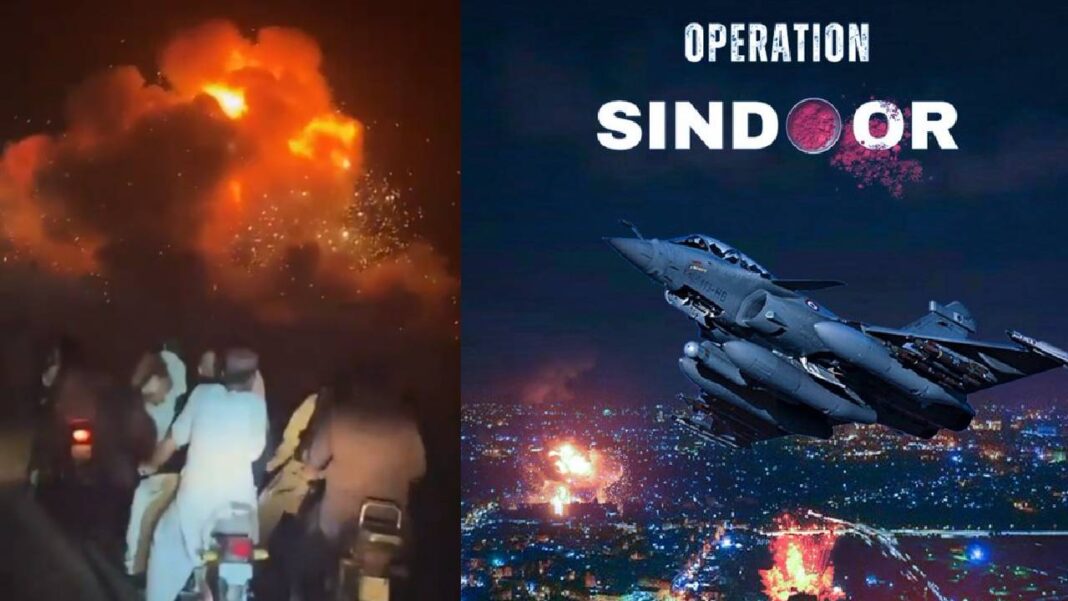
In a strong retaliation to the Pahalgam massacre, India’s armed forces early Wednesday destroyed nine terror sites including that of Jaish-e-Mohammad and Lashkar-e-Taiba in Pakistan and Pakistan-occupied Kashmir (PoK) using deep strike missiles in a 25-minute-long “measured and non-escalatory” mission.
Foreign Secretary Vikram Misri said India decided to carry out the “proportionate” strikes to bring the perpetrators and planners of the Pahalgam attack to justice as there was “no demonstrable step” from Pakistan to act against terrorist infrastructure on territories under its control. It was for the first time since the 1971 Indo-Pak war that India carried out an aerial attack deep inside Punjab province of Pakistan.
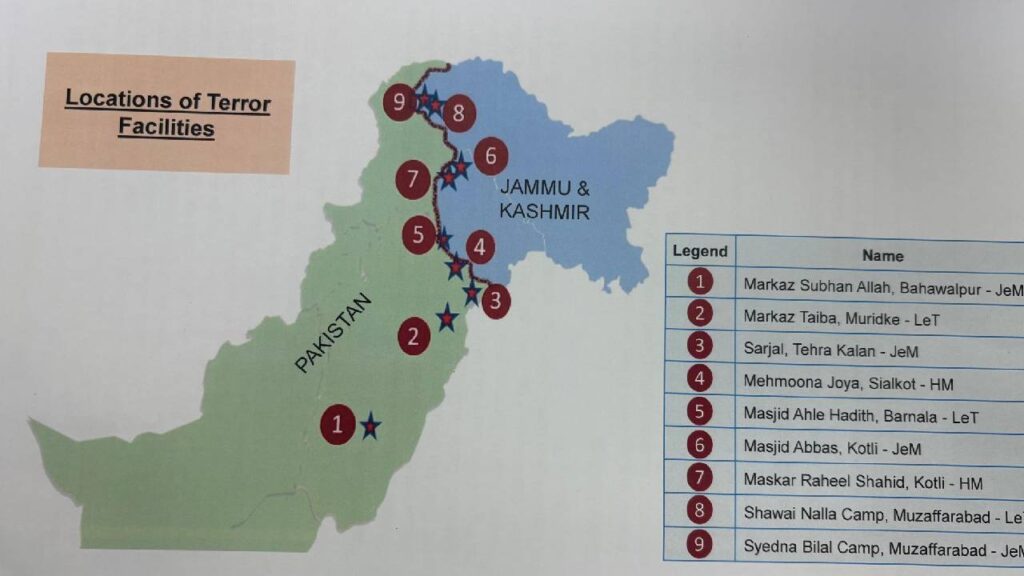
Fifteen days after the Pahalgam carnage on April 22, the targets for the military response codenamed ‘Operation Sindoor’ included the Jaish-e-Mohammad(JeM) stronghold of Bahawalpur in Punjab province that is located at over 100 km from the Indian border.
Official sources said Prime Minister Narendra Modi was monitoring the operation closely through the night. Later at a meeting of the Union Cabinet, he hailed the Indian armed forces for carrying out the successful targeted strikes at the terror camps.
The sources said it was Prime Minister Modi who picked the evocative term ‘Operation Sindoor’ to codename the Indian response. ‘Sindoor’ is a reference to the red vermillion that married Hindu women wear to signify their married status.
In the Pahalgam attack, the husbands of several women were killed in front of them, including an Indian Navy officer. A total of 26 people, mostly tourists, were killed in the carnage.
Under ‘Operation Sindoor’, the Indian military targeted Markaz Taiba of Lashkar-e-Taiba (LeT) in Muridke, Markaz Subhan Allah of Jaish-e-Mohammad (JeM) in Bahawalpur and Hizbul Mujahideen’s Mehmoona Joya Facility in Sialkot and LeT’s base in Markaz Ahle Hadith in Barnala and its camp in Muzaffarabad’s Shawai Nalla, military officials said. Muridke, located a short distance from Lahore, is home to a sprawling “markaz” or base of the LeT.
Indian officials said the strikes on all nine targets including Bahawalpur and Muridke were successful. It is learnt that an array of weapons including Scalp deep-strike cruise missiles, the Hammer smart weapon system and guided bomb kits were used in striking the terror camps.
The operation was conducted from 1:05 am to 1:30 am and all the targets were neutralised with clinical efficiency, two women officers — Col Sophia Qureshi of the Army’s Corps of Signals, and Wing Commander Vyomika Singh, a helicopter pilot of the IAF, said at a media briefing alongside Misri.
Around 15 minutes after the operation ended, the defence ministry said in a statement at 1.44 am: “A little while ago, the Indian Armed Forces launched ‘Operation Sindoor’, hitting terrorist infrastructure in Pakistan and Pakistan-occupied Jammu and Kashmir from where terrorist attacks against India have been planned and directed.”
The statement said the actions by the Indian Armed Forces have been “focused, measured and non-escalatory” in nature and that no Pakistani military facilities have been targeted.
“India has demonstrated considerable restraint in the selection of targets and the method of execution.”
In his remarks, Misri said the Indian military carried out the “measured, non-escalatory, proportionate, and responsible” military strike to dismantle terrorist infrastructure to “deter and pre-empt” any further terrorist strikes.
“Our intelligence monitoring of Pakistan-based terrorist modules indicated that further attacks against India were impending.”
He further said India’s actions were in line with the UN Security Council’s statement about holding perpetrators, organisers, financiers and sponsors of the Pahalgam attack accountable.
National Security Advisor Ajit Doval spoke to US Secretary of State Marco Rubio and his counterparts in several countries, including Saudi Arabia and the United Arab Emirates.
Officials said Doval told his counterparts that India has no intent to escalate tensions but is prepared to “retaliate resolutely” if Pakistan does so.
Wing Commander Singh said Indian armed forces are fully prepared to respond to Pakistani “misadventure, if any, to escalate the situation.”
“The point of impact in each of the target was a specific building or a group of buildings,” said Singh.
Sources in the Indian military establishment said all air defence units have been put on alert along the frontier with Pakistan.
In a high-level meeting with the top defence brass on April 29, Prime Minister Modi gave the armed forces “complete operational freedom” to decide on the mode, targets and timing of the response to the Pahalgam attack. He had also emphasised the national resolve to deal a “crushing blow to terrorism”.